|
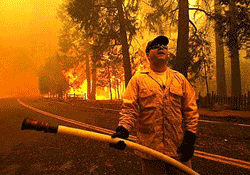
Each year, wildfires destroy hundreds of homes and acreage.
When a wildfire does strike, it can occur with little warning and spread
quickly. Fire crews and equipment can be overwhelmed by the task of fighting a
rapidly advancing wildfire. There simply may not be enough personnel and
equipment to defend every home.
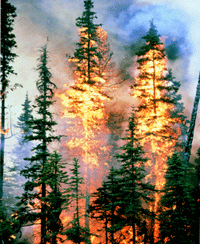
Falling embers and brands, sometimes from miles away, presents one of the greatest dangers in
a wildfire situation. A single hot ember could make your home or property a
secondary incident, with fire department resources already devoted to fighting
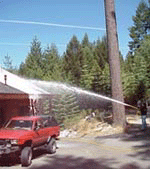
the main fire miles away. Our systems can help you to Defend Your Defensible
Space ®
before your local fire protection agency arrives, but only if you are
prepared.
Being prepared can give you the edge in making your home a
"winner" instead of a "loser" with
both lives and property being saved if you take a few simple precautions...
|
 |
-
Plan Ahead Early
-
Create
Defensible Space
-
Spark Proof Your Home
-
Set Up A Water Supply
&
Delivery System
-
Add Foam
or Gel to your
Delivery System
-
Know when to get out
|
|
1. PLAN AHEAD
EARLY
Don't wait until the fire
season has started. Precautions should be taken before
summer to help save your home, even if fire comes while you are away. A
well prepared home has a better chance of being saved than an unprepared one.
Even by
doing some simple cleanup and adding a foaming kit to each of your garden
hoses, you will have the beginnings of a basic plan of defense. |
 |
2. CREATE
DEFENSIBLE SPACE
Fires are spread and fuelled by
flammable grasses, weeds, trees and bushes.
-
Cut down grass, clear
leaves and dead undergrowth within 30-50 feet
of buildings
-
Clear all dry grass
and bark well back from the walls
-
Space trees so that
there is NOT a continuous canopy from brushland to house
-
Remove tree limbs
which overhang the roof or decks.
-
All nearby trees
should have lower branches pruned away to provide a vertical
firebreak which will prevent the ground fire spreading into them
-
Keep gutters clear of leaves & twigs and screen with
metal gutter guards.
3. SPARK PROOF YOUR HOME
Many houses lost in wildfires have caught fire ON THE INSIDE, caused by
burning debris or sparks blown through uncovered openings - windows,
doors, eaves, the roof space or under the house. This is a very
important point. Your home - and your family - have a much better
chance of surviving a bushfire if the house is spark proof.
-
Treat
all exterior wood surface with intumescant paint or other fire rated
coating.
-
Install metal mesh or
solid screens will seal windows, doors, ventilators and
skylights.
-
Eaves and under-floor
areas should be boxed in or screened over
-
Pay particular
attention to gaps in the roof area, along the ridge cap and facia.
|
4. SET UP A WATER SUPPLY AND
DELIVERY SYSTEM
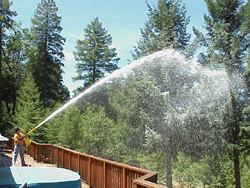
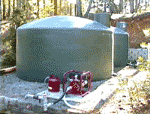
It is essential to make provision for an adequate water supply for
firefighting. You cannot rely on public water mains or electricity
during a wildfire. Your water supply and delivery system should be
totally independent of utilities which, in the event of an emergency,
may be inadequate or non-existent. (Remember the Oakland Hills fire in the SF Bay
Area?)
Tanks, dams and swimming pools can provide
necessary reserves provided you have the proper pump and enough hose to reach
all areas to be protected. Ideally the system should provide
coverage to the entire house as well as the defensible space around it.
|

|
The delivery system should provide a MINIMUM
100 PSI nozzle pressure
AT THE RATED FLOW OF THE NOZZLE YOU WILL BE USING. This provides compatibility
with and proper operation of standard
firefighting nozzles and foam equipment. Remember to take into account
friction losses through long hose runs too!
IMPORTANT NOTE ON PUMPS: Do
not be misled by some pump dealers who claim high flow rates and pressures but
don't provide a pump curve. Ask to see a pump curve before you buy and insist on
100+ psi at your desired operating flow!
In addition, your delivery system
should be easy to use. Reading a manual is the last thing you want to be
doing in the middle of a fire event!
Your water supply and delivery system should also be clearly labeled and
designed
to provide easy access for your local fire
agency. Check with your local fire department for recommendations on
making your equipment readily accessible.
Also, be sure to test your equipment at
least annually to ensure proper operation, to account for all
supplies and to make sure it is working as designed. Gasoline engines need their oil and gas replaced no less
than once a season. The last thing you want to be doing during a fire is
servicing your pumps engine!
NOTE: The NFPA has a formula for calculating
the amount of water required to protect a specific structure. (Ref: NFPA 1142,
Standard on Water Supplies for Suburban and Rural Fire Fighting, 1999 Edition)
|
5. ADD FOAM OR GEL TO YOUR
DELIVERY SYSTEM
Foam concentrates can increase the coverage of a limited water supply up
to 5 times! Foam breaks down the waters surface tension thereby improving waters penetration into porous surfaces and
slowing its evaporation. In addition, the bubbles created act as an insulating barrier and
help reflect infrared heat away from protected surfaces. When applied to
the defensible space around your home, foam can increase waters effectiveness 5x
or more!
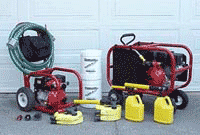
We offer a variety of foaming kits allowing the addition of foam to everything
from a standard garden
hose to portable pumps or whole house hydrant systems.
|
 |
6. KNOW WHEN TO GET OUT
Your property can be replaced but not your life or the life of a loved one.
The equipment we sell can provide a extra level of protection against the threat
of a wildfire. However, no matter what steps you take there is no
guarantee that you can protect your property. Although this equipment can
be used to directly attack a fire, unless you have no other choice that is best
left to professional firefighters.
Always have a evacuation plan in
mind and when in doubt, get out!
6. ADDITIONAL RESOURCES
For more information on
defensive space and what you can do to protect your home & family, check out
these related website links:
NOTE: If any of the above links do not work the providers server may
be temporarily down. The information contained on this page
has been compiled from a variety of sources. No guarantee is
made as to the accuracy of any of the information and the views
expressed are offered only as general information. Information
contained on linked pages are those of the respective authors and
are not necessarily the opinions of Western DataLynx Inc, it's
employees or dealers. Firefighting is serious business and we
advise you to consult with your local fire agency for specific
recommendations regarding fire safety in and around your home and
property.
Have questions or want to place an order? Write
us at sales@homefirefightingsystems.com
or CALL TOLL FREE (866) 626-3473
Telephone Sales Hours:
Tuesday-Saturday
10am-5pm Pacific Time
Will-Call / Shop Hours:
By Appointment Only
|

Systems & Equipment
A Division of Western DataLynx Inc. |
Back
To Our Home Page
Firefighter® is a registered
trademark of Davey Products Pty Ltd.
Home Firefighting® and Defend Your Defensible Space®
are registered trademarks of
Western DataLynx Inc.
All material copyright © 1998-2008 Western DataLynx
Inc.
Click here to read our
privacy policy.
|